
Why Your Main Service Panel Upgrade Could Cost You Thousands More on Solar — If It's Not Done Right
By the Experts at Ally Electric and Solar | Serving Homeowners Since 2010
You've probably heard a lot lately about main service panel upgrades, whole home electrification, and rooftop solar. These are some of the smartest investments a homeowner can make — and for good reason. But here's something most electricians won't tell you upfront: the way your panel upgrade is done today will directly determine how much you pay for solar tomorrow.
At Ally Electric and Solar, we've been designing and installing solar systems since 2010. In that time, we've seen the same costly mistake made over and over again — not by homeowners, but by electricians who don't think ahead. The culprit? Current Transformers, or CTs — and where they get placed during a panel upgrade.
If that term is new to you, don't worry. By the end of this article, you'll understand exactly what CTs are, why they matter, and why choosing the right company for your main service panel upgrade could save you thousands of dollars down the road.
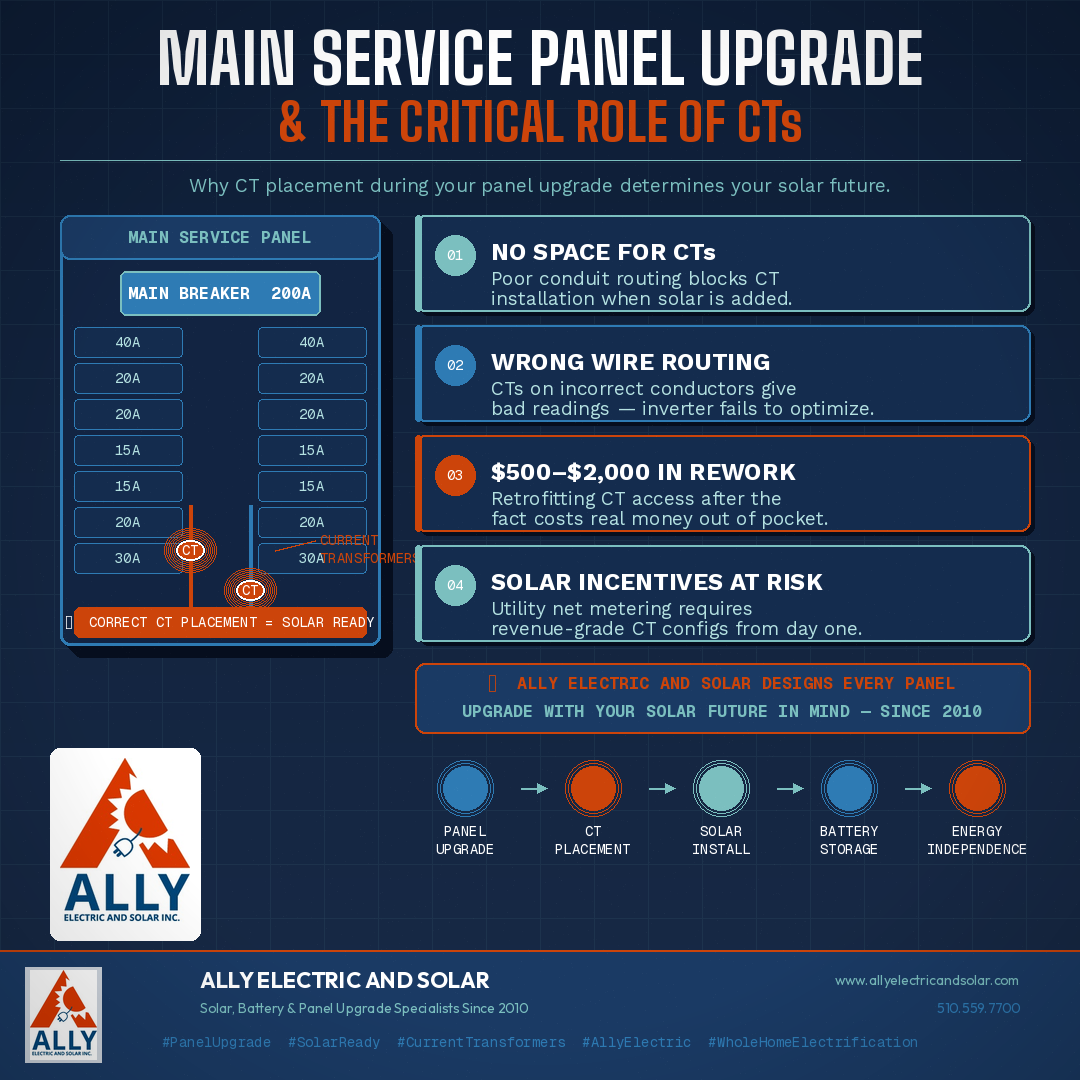
Infographic by Ally Electric and Solar showing a main service panel upgrade with current transformer (CT) placement diagram, breaker layout, and the four costly consequences of improper CT installation when adding solar.
What Is a Main Service Panel Upgrade — and Why Does It Matter?
Your main service panel (also called an electrical panel, breaker box, or load center) is the heart of your home's electrical system. It receives power from the utility grid and distributes it to every circuit in your home — your lights, appliances, outlets, HVAC system, and more.
Many older homes were built with 100-amp or even 60-amp panels. Today's energy demands — especially with EV chargers, heat pumps, induction ranges, and whole home electrification — often require a 200-amp or even 400-amp service upgrade.
A main service panel upgrade is one of the most important electrical projects you can undertake. Done right, it sets your home up for decades of clean, efficient energy use. Done wrong — or done by someone who isn't thinking about your complete energy future — it can create expensive headaches the moment you try to add solar or other upgrades.
What Are Current Transformers (CTs) — and Why Should You Care?
A Current Transformer, or CT, is a small sensing device that clamps around an electrical conductor (typically your main service lines) to measure how much electricity is flowing through it.
CTs are a critical component in:
Solar energy systems — to monitor how much power your panels are producing vs. how much your home is consuming
Battery storage systems — to determine when to charge, discharge, or export energy
Home energy management systems — like those used by Sense, Span, or smart panel controllers
Time-of-use energy optimization — so your system knows when to pull from the grid vs. your battery
In short, CTs are the eyes of your home's energy system. Without accurate CT placement, your solar inverter doesn't know what your home is using. Your battery doesn't know when to kick in. Your monitoring app shows inaccurate data — or nothing at all.
The Problem: Most Electricians Don't Think About Solar When They Upgrade Your Panel
Here's where things go wrong.
When a general electrician performs a main service panel upgrade, their job — in their mind — is simple: install a new panel, move the breakers, restore power, pass inspection. Done.
But if they don't consider where solar production CTs, revenue-grade metering CTs, or whole-home energy monitoring CTs will need to be installed later, you could end up with:
1. No space for CT installation Panel enclosures have limited room. If conduit runs, wire bundles, or breaker positioning block access to the main service conductors, there may be physically no clean place to clamp a CT when solar is added later — requiring a partial teardown of the work already done.
2. CT placement on the wrong conductors CTs must be placed on the right wires — in the right location relative to the meter and the panel — to give accurate readings. An electrician unfamiliar with solar system design may route wiring in a way that makes proper CT placement impossible without redoing sections of the installation.
3. Incompatible metering configurations Some utility interconnection agreements and solar incentive programs (including net metering) require revenue-grade metering or specific CT configurations. If your panel upgrade wasn't designed with this in mind, you may not qualify for the best solar export agreements — or you may need to bring in a separate electrician (at your expense) to reconfigure the installation.
4. Costly retrofits at solar installation time We've seen it dozens of times at Ally Electric and Solar: a homeowner gets a panel upgrade from a general electrician, then calls us six months later to install solar. When our team inspects the panel, we find that the CT installation requires rerouting conduit, cutting into drywall, or pulling a new permit on work that was just completed. That's money out of your pocket — often $500 to $2,000 or more in additional labor — for a problem that never should have existed.
Whole Home Electrification: The Stakes Are Even Higher
Main service panel upgrades are increasingly being driven by the shift to whole home electrification — replacing gas appliances with electric alternatives. This includes:
Heat pump HVAC systems replacing gas furnaces
Heat pump water heaters replacing gas water heaters
Induction ranges replacing gas stoves
EV chargers for one or two electric vehicles
Battery backup systems for grid outages
Each of these loads needs to be carefully accounted for in your panel design. And when you layer solar production and battery storage on top of that, the CT placement and metering strategy become even more critical.
A whole home electrification plan done by a solar-aware electrical contractor isn't just an upgrade — it's a coordinated energy strategy. Every wire run, every breaker position, and every CT location is chosen with the full picture in mind.
A plan done by someone who only thinks about today's job? It's a puzzle with missing pieces.
What Ally Electric and Solar Does Differently
We've been designing integrated solar and electrical systems since 2010. In that time, we've learned that the best installations aren't just technically sound — they're forward-thinking.
When Ally Electric and Solar performs a main service panel upgrade, here's what that means in practice:
We design for where you're going, not just where you are. Before we pull a single wire, we ask: Is solar in your future? Do you have an EV or plan to get one? Do you want battery backup? The answers shape every decision we make about your panel.
We ensure proper CT access from day one. Our electricians know exactly where production CTs, consumption CTs, and metering CTs need to be installed for every major solar inverter brand — SolarEdge, Enphase, SMA, Generac, and more. We design conduit runs and wire routing so that CT installation is clean and code-compliant when your solar system goes in.
We coordinate with your utility requirements. Net metering, time-of-use rates, and interconnection agreements often have specific metering requirements. We know what your utility needs — because we've navigated those interconnection agreements hundreds of times.
We pull the right permits and pass inspection the right way. A panel upgrade that's done without proper permits is a liability — especially when you go to sell your home or file an insurance claim. All Ally Electric and Solar work is fully permitted and inspected.
We speak the language of solar from the start. When your solar installer shows up on the day of installation, they shouldn't be surprised by what they find in your electrical room. With Ally Electric and Solar, they won't be — because we think like solar installers, because we are solar installers.
Questions to Ask Before Hiring Anyone for a Panel Upgrade
If you're getting quotes for a main service panel upgrade — whether from us or anyone else — here are the questions that will tell you whether that contractor has your long-term interests in mind:
Do you have experience with solar installations? If the answer is no or vague, proceed with caution.
Where will the CTs be placed if I add solar later? A blank stare is a red flag.
How will you ensure CT access isn't blocked by conduit or wiring? They should have a specific answer.
Are you familiar with my utility's interconnection and metering requirements? This matters for future solar export credits.
Will this panel support a future battery storage system? The answer should be yes, and they should explain how.
Do you pull permits for panel upgrades? Always yes. No exceptions.
The Bottom Line: Your Panel Upgrade Is an Investment in Your Energy Future
A main service panel upgrade isn't just electrical maintenance — it's the foundation of your home's energy system for the next 30 years. In an era of rising electricity rates, EV adoption, whole home electrification, and rapidly expanding solar and battery storage options, getting that foundation right is more important than ever.
Choosing a contractor who understands solar, CTs, energy monitoring, and whole home electrification isn't a luxury — it's the only way to protect your investment.
At Ally Electric and Solar, we've spent over a decade building that expertise. We've seen what happens when panel upgrades are done without a solar-aware mindset — and we've spent a lot of time fixing those mistakes for homeowners who didn't know what questions to ask the first time around.
We'd rather help you get it right from the start.
Ready to talk about your main service panel upgrade, solar installation, or whole home electrification plan?
Contact Ally Electric and Solar today for a free consultation. Let's design your home's energy future — the right way, from the ground up.
Ally Electric and Solar has been installing solar systems and performing electrical upgrades for homeowners since 2010. Our licensed electricians and NABCEP-certified solar professionals bring a fully integrated approach to every project — because your home deserves more than a contractor who only thinks about today's job.