
LiFePO4 vs. LiPo Batteries for Home Solar Storage: Why Chemistry Matters More Than You Think
By the Experts at Ally Electric and Solar | Solar & Battery Storage Specialists Since 2010
When homeowners start exploring solar battery storage, the conversation usually centers on one thing: capacity. How many kilowatt-hours can it store? How long will it power my home during an outage?
Those are fair questions. But there's a more fundamental question that too few people ask before signing a contract:
What kind of battery chemistry is inside that storage system — and is it safe to put in my home?
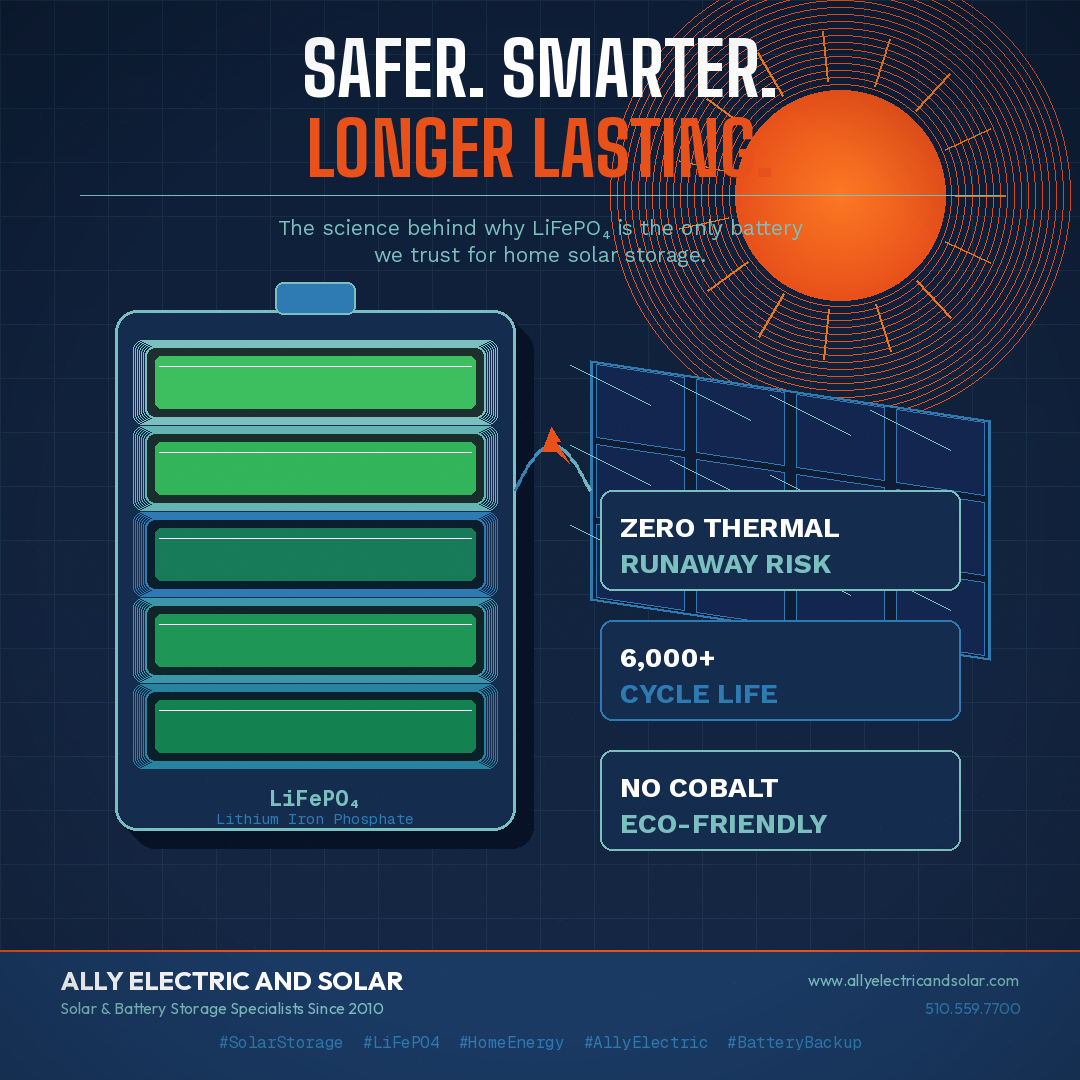
LiFePO4 batteries are safer, longer-lasting, and fire-resistant — the only chemistry we trust for home solar storage. Learn why from Ally Electric and Solar.
At Ally Electric and Solar, we've been installing solar and battery storage systems since 2010. We've watched the battery market evolve rapidly, and we've seen firsthand how the chemistry inside a battery affects not just performance, but safety — for your family, your home, and your investment.
This post breaks down the key difference between the two most common lithium battery chemistries on the market today: LiFePO4 (Lithium Iron Phosphate) and LiPo (Lithium Polymer). By the end, you'll know exactly what to look for — and what to watch out for — when choosing a solar battery storage system.
The Battery Behind Your Solar System: Why Chemistry Is Everything
Solar panels generate electricity when the sun is shining. But the sun doesn't shine 24 hours a day — and the grid doesn't always cooperate when you need it most. That's where battery storage comes in.
A solar battery storage system stores the excess energy your panels produce during the day so you can use it at night, during peak rate hours, or when the grid goes down. It's one of the most valuable additions you can make to a solar installation.
But not all solar batteries are created equal. The chemistry that powers the battery determines how it charges, how long it lasts, how it handles stress — and critically, what happens when something goes wrong.
LiFePO4: The Gold Standard for Home Solar Battery Storage
LiFePO4, or Lithium Iron Phosphate, is widely considered the safest and most stable lithium battery chemistry available for residential and commercial energy storage. Here's why.
Thermal Stability — The Big One
The most important safety characteristic of any battery is how it responds to heat, overcharging, or physical damage. With most lithium chemistries, stress can trigger thermal runaway — a chain reaction where the battery rapidly overheats, releases flammable gases, and catches fire. It's the same phenomenon responsible for high-profile battery fires in consumer electronics, electric vehicles, and even grid-scale storage facilities.
LiFePO4 chemistry is fundamentally different. The iron-phosphate bond in the cathode material is exceptionally stable. Even when exposed to overcharging, high ambient temperatures, or physical puncture, LiFePO4 batteries resist thermal runaway in ways that other lithium chemistries simply cannot match. The chemistry does not easily release oxygen — and without oxygen, combustion cannot sustain itself.
In plain terms: LiFePO4 batteries are extremely difficult to set on fire. For a battery installed in your garage, basement, or utility room, that's not a minor detail. That's peace of mind.
Long Cycle Life
LiFePO4 batteries are built to last. Most quality LiFePO4 solar storage systems are rated for 3,000 to 6,000+ charge/discharge cycles before reaching 80% of their original capacity. Cycle through the battery once a day and you're looking at 8–16 years of reliable service — well-matched to the 25-year lifespan of a solar panel system.
Wide Temperature Tolerance
LiFePO4 chemistry handles temperature extremes better than most alternatives, maintaining stable performance in both hot summers and cold winters — a meaningful advantage for homeowners in climates with wide seasonal swings.
No Memory Effect
LiFePO4 batteries don't suffer from "memory effect," meaning you can charge them partially, discharge them partially, and repeat without degrading long-term capacity. This makes them well-suited to the variable charge/discharge patterns of a real solar home.
Environmentally Responsible
Iron and phosphate are among the most abundant and non-toxic minerals on earth. LiFePO4 batteries contain no cobalt — a material associated with significant environmental and ethical concerns in mining — making them a cleaner choice across their entire lifecycle.
LiPo: Higher Power Density, Higher Risk
LiPo (Lithium Polymer) batteries use a polymer electrolyte and a different cathode chemistry — typically lithium cobalt oxide or related compounds. They're widely used in consumer electronics, drones, and RC vehicles because of one primary advantage: energy density.
LiPo batteries can pack more energy into a smaller, lighter form factor than most alternatives. For a smartphone or a racing drone, that matters enormously. But for a home solar battery system installed in a fixed location? The calculus changes significantly.
Thermal Runaway Risk Is Real
LiPo chemistry is inherently less stable than LiFePO4. When a LiPo battery is overcharged, over-discharged, physically damaged, or exposed to high temperatures, it is significantly more likely to experience thermal runaway — and when it does, the consequences can be severe. LiPo fires burn hot, spread fast, and are notoriously difficult to extinguish.
This is not a theoretical concern. There are documented cases of LiPo battery fires in homes, warehouses, and commercial buildings around the world. Fire departments have issued specific guidance on LiPo battery storage and handling precisely because of this risk.
Swelling and Degradation
LiPo batteries are prone to swelling — physically expanding — when they degrade, are overcharged, or experience temperature stress. Swelling compromises the structural integrity of the battery pack, creates dangerous pressure buildup, and can lead to rupture or fire if not caught and addressed. In a consumer device, a swollen LiPo battery is a nuisance. In a large-format home storage system, it's a serious safety concern.
Shorter Useful Life Under Real-World Conditions
LiPo batteries generally offer fewer charge/discharge cycles than LiFePO4 under comparable conditions, meaning more frequent replacement and higher long-term cost of ownership — particularly relevant for a solar storage system expected to serve a home for a decade or more.
Stricter Safety Management Required
Because of their instability, LiPo-based systems require sophisticated battery management systems (BMS) with tight monitoring of voltage, temperature, and state of charge. This isn't impossible to engineer — consumer electronics manufacturers do it every day. But it adds complexity, cost, and another potential point of failure. One compromised BMS can mean the difference between a manageable fault and a dangerous fire.
Side-by-Side: LiFePO4 vs. LiPo for Solar Battery Storage
Feature LiFePO4 LiPo Thermal Runaway Risk Very Low Moderate to High Fire Safety Excellent Poor to Moderate Cycle Life 3,000–6,000+ cycles 500–1,500 cycles (typical) Temperature Tolerance Wide range Narrower range Swelling Risk Very Low Moderate to High Energy Density Moderate High Environmental Impact Low (no cobalt) Higher (often cobalt-based) Best Application Home/commercial solar storage Consumer electronics, drones
What This Means When You're Shopping for a Solar Battery
The residential solar battery market is crowded, and not every product is equally transparent about the chemistry inside. Here's what to look for and ask about when evaluating solar storage systems:
Ask directly: Is this a LiFePO4 battery? Reputable manufacturers will answer this question immediately and proudly. If a salesperson is evasive or unclear about the battery chemistry, treat that as a red flag.
Look for UL 9540 and UL 9540A listings. These are the key safety certifications for energy storage systems in the United States. UL 9540A specifically evaluates how a battery system responds to thermal runaway — including whether a fire in one cell can propagate to adjacent cells. LiFePO4-based systems generally perform significantly better on this test.
Consider where the battery will be installed. An attached garage, a living space utility room, or a basement are common installation locations. In any of these spaces, the fire safety profile of the battery chemistry should be a primary consideration — not an afterthought.
Think long-term. A solar panel system is a 25-year investment. Your battery storage should be designed to match. LiFePO4's superior cycle life and durability mean fewer replacements, lower total cost of ownership, and a storage system that's still performing well a decade after installation.
The Batteries Ally Electric and Solar Recommends — and Why
Since 2010, Ally Electric and Solar has installed solar and battery storage systems for hundreds of homeowners. We've evaluated virtually every major battery product on the market — and our recommendation for residential solar storage has been consistent: LiFePO4-based systems, from manufacturers with proven safety track records.
The most widely deployed LiFePO4 solar storage systems in the U.S. residential market include products built on this chemistry from leading manufacturers. We work with the products we trust — and we explain exactly why we recommend them to every one of our customers.
We've seen what happens when cost is prioritized over chemistry. We've been called to homes where battery systems from less reputable sources showed signs of swelling, overheating, or improper installation. We've watched homeowners pay twice — once for the cheaper system and again to replace it correctly.
Getting solar battery storage right the first time isn't just about performance. It's about protecting your home and your family. That's a responsibility we take seriously on every installation we complete.
Solar + Battery Storage: The Complete Picture
A well-designed solar and battery storage system does more than reduce your electric bill. It gives you:
Energy independence — less reliance on an increasingly stressed grid
Backup power — protection during outages that are becoming more frequent across the country
Rate optimization — the ability to store cheap solar energy and avoid expensive peak-rate grid power
Home value — solar and storage are among the highest-ROI home improvements available today
Reduced carbon footprint — clean energy, stored cleanly, used efficiently
But all of those benefits depend on a system that's designed correctly, installed by licensed professionals, and built around components that are genuinely safe for residential use.
The battery chemistry is where that story starts.
Ready to Explore Solar and Battery Storage for Your Home?
At Ally Electric and Solar, we don't just install solar panels. We design complete energy systems — from the panels on your roof to the battery in your utility room to the upgraded panel that ties it all together. And we've been doing it since 2010, with the hands-on experience and technical knowledge to get every detail right.
If you're ready to explore solar battery storage, whole home electrification, or a main service panel upgrade — or if you just want to understand your options — we'd love to talk.
Contact Ally Electric and Solar today for a free consultation. Let's build an energy system you can count on — safely, efficiently, and for the long haul.
Ally Electric and Solar is a licensed electrical and solar contractor specializing in residential and commercial solar installations, battery storage systems, main service panel upgrades, and whole home electrification. We've been serving homeowners since 2010 with fully permitted, professionally engineered energy solutions.